Kings of the Beach
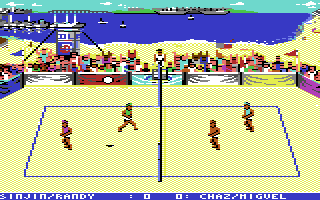
sports game for Commodore 64, 1989
------------------------------------------------------------------------------
Back in the 30s, the guys on the beach
in Santa Monica, California, would get
six-on-six volleyball games going.
Sometimes there weren't enough players,
but the guys wanted to play so bad their
shorts ached. So, what the hell, they
gave it a try: two on two. At first they
played on a quarter of the court. Wimpy.
Then they played on half a court. Still
wimpy. So they decided to go whole hog
and play the entire court... WILD!

By the 1950s, the sport was still
uncomplicated. No audiences. No
publicity. No prizes. No babes. The guys
were just kings of their own little
world. But twenty years of being kings
without a kingdom was enough. So they
coaxed a Hollywood star to be the
Volleyball Queen (Greta Tyson for you
trivia buffs) and the attention
they - she - got was astounding. It was
no longer just an obscure game; it was
now a semi-obscure game... with babes.

Despite the promise of babes, the
sport's popularity grew slowly. It would
have to wait until the health-conscious
80s before rocketing in popularity.
Today, the game has outgrown its
Southern California britches. Pro beach
volleyball has fans in places as diverse
as San Francisco, Chicago, New York,
Rio de Janeiro, and Australia. Prize
money can go as high as $100,000 for a
tournament. If these guys still have a
beach bum image, then it's a
gold-tinted one.

Fifty years after the first volleyball
was dug out of the sand, life's a lot
different for the beach volleyballer.
One thing's still the same though. Moti-
vation. It's all about being King of the
Beach. Where else would the royal garb
be a golden tan? And the queen dressed
in a leopard-skinned bikini?

INTRODUCTION SCREEN

Once the game loads, you'll see the
introduction screen. When you're done
looking at the intro, press any key to
move on to the profiles for Sinjin and
Randy. When you're done reading the
profiles, press any key to go
to the beach.

THE BEACH SCENE

Meet Spike. He's a kind of a volleyball
perennial. Ever since he was old enough
to clench his pudgy little fingers into
a fist, he's been spikin'. Spike will be
your beach escort. He'll make sure that
you get into all the right places and
that you don't get a third-degree sun-
burn before the day's out. When you want
to enter a court or the registration
tent, use a joystick in either port to
move Spike on your choice; press the
joystick button to get in.

REGISTRATION TENT

The registration tent shades the
trophies from the hot sun. (The sponsors
don't want you scorching your lips when
you kiss it after your big victory.) The
tent also lets you take care of a few
details before you start your match.

              REGISTRATION

      SINJIN         X JOYSTICK 1
      RANDY            COMPUTER

      PRACTICE CHAR    SINJIN
      PLAYING MODE     COOPERATIVE
      MATCH LEVEL      EASY
      SOUND            ON
      PASSWORD
      EXIT TO BEACH

Move the X next to the option you want
to change and press the joystick button.
Then move the joystick left or right to
scroll through all the options. When
you've got the option you want, press
the joystick button again to set
your choice.

SINJIN/RANDY:

You need to pick the input devices that
will control both players.

CONTROLLING THE GAME:

You must use a jostick to control the
game. If you're playing alone against
the computer, plug your joystick in
port 2. You can't use a mouse or the
keyboard to control action.

MOVING:

To control your players or Spike, move
the joystick in the direction you want
the player to go.

SERVING:

Skyball ..... Click the joystick button.

Flat ........ Move the joystick left.
              Click the joystick button
              once to toss the ball up
              and once again to hit it.

Jump ........ Move the joystick right.
              Click the joystick button
              once to toss the ball up
              and once again to hit it.

HITTING:

You get three hits to get the ball over
the net.

Bump/Dig .... Click the joystick button
              (works on the first and
              third hit).

Set ......... Click the joystick button
              (works on the second hit).

Spike/Block . Double-click the joystick
              button.

NOTES ON HITTING:

* When you double-click, you will either
  spike or block the ball - whichever is
  appropriate for the situation you're
  in.

* When you single-click, you will either
  bump/dig or set the ball. You will
  bump/dig if this is your first or
  third hit. You will set if this is
  your second hit.

COMPUTER:

The computer will control that player.

PRACTICE CHAR:

Choose either Randy or Sinjin. This is
the guy you'll use on the practice
courts. Sinjin's the one who wears a
pink top.

PLAYING MODE:

Choose from cooperative or competitive.
In a two-player game, cooperative lets
you be partners with your friend, while
competitive sticks him on the other side
of the net. Two-player competitive can
only take place on Match Court.

MATCH LEVEL:

The Match Court is the place where
you'll polish your game in preparation
for the big tournament. Choose from
three skill levels for this court: easy,
medium, difficult.

SOUND:

Turn off to kill the music and shut up
your enthusiastic crowd. Or leave it on
and enjoy the sounds.

PASSWORD:

Each time you win a beach in the
tournament (you gotta win three games to
win the beach), you get a password for
the next stop on the tour. This is where
you enter the password to pick up where
you left off. There's one password for
each town.

EXIT TO BEACH:

Takes you out of the registration tent
and back to the beach. You can choose
from any of the courts.

COMMAND KEYS

[S] .... Stop .......... Pauses the
                         game. Press any
                         other key to
                         continue.

[E] .... Exit .......... Return to
                         beach.

[F3] ... Argue 1 ....... Sends player 1
                         to argue a call
                         in Tournament
                         or Match Play.

[F5] ... Argue 2 ....... Sends player 2
                         to argue a call
                         in Tournament
                         or Match Play.

[V] .... View Stats .... Shows the stats
                         for a game in
                         progress. Click
                         joystick button
                         to continue.


   1988 PRO BEACH VOLLEYBALL RESULTS:

 Sinjin and Randy won 10 pro
 tournaments in 1988, the most of any
 duo on tour. They topped their record
 winning season with the USA Pro Beach
 Volleyball Championship in Hermosa
 Beach, California.


PLAYING LIKE KINGS

Kings of the Beach builds in the playing
styles of Sinjin Smith and Randy
Stoklos. While you gotta play smooth and
make all the right moves to be a winner,
programmed player intelligence really
helps out. Through hours of discussion
and meetings with the two stars, we've
set up statistical shooting percentages
and accurate playing styles that
simulate those of Smith and Stoklos
in real life.

Randy Stoklos is the net man. He's a
fearsome shot blocker and vicious
spiker. Sinjin Smith - whose spikes can
also bite - is a step faster in the sand
and is great to have in the backcourt
for covers and digs. On spikes and sets,
the percentages help you locate shots
and will actually help you place the
ball to open parts of the court.
Similary, the computer intelligence will
help you get to the spot where the ball
is going to on serves and returns.
Through practice and patience, you'll
learn how to play these characters to
their fullest potential... and become
Kings of the Beach.

ON OFFENSE

Here's some advice for novices. No
matter how pale you are, don't smear on
the sunscreen. You'll grease the ball to
high heaven. And don't wear the T-shirt
that says "Beach volleyballers do it in
the sand." Lame. They'll dub you "Dork
of the Beach" and cast you adrift in a
dinghy. And finally, don't forget to
practice. Or else you won't know what to
do when that big white satellite comes
into your face at 100 mph.

THE PRACTICE COURTS

There are three practice courts. With
enough practice, anybody can become a
beach assassin. Each court concentrates
on one shot.

Only one player can practice at a time.

BUMP

The bump is a shot where your hands are
clasped together and your forearms are
extended. The ball should "bump" off
your forearms a few inches above your
clasped hands. In this court, your coach
will serve the balls over the net so you
can bump them back.

SET

Use this move to set your partner up for
the spike. To set the ball, you'll have
your hands above your head with arms
slightly bent. When the ball comes down,
you'll gently loft the ball skyward and
towards the net. Your teammate will then
attempt to spike the ball into your
opponent's court. A couple of coaches
will help you out. One coach will bump
the ball to you and let you set it
towards the net for a return. It's not a
Hollywood move, but it's a critical part
of the game.

SPIKE

Make a fist. Jump real high. Smash the
ball into the opponent's court (or maybe
even into the opponent). That's spike.
It's a tough one to master: too early or
too late and you've got a fluff. For a
spike to be really effective (or nasty),
you'll want to spike just at the right
time and as close to the net as
possible. This makes the ball rocket
into the sand at a steep angle and makes
it very hard to return.

A TIP ON HITTING

The ball always lands on its own shadow.
To be in the right position when the
ball comes down, stay on the shadow. And
don't forget to keep your eye on the
ball unless you want a hand full of air.

Don't worry if Randy or Sinjin move
without you touching your joystick. If
you're close to the ball, the computer
will fine-tune your position; you can't
move again until you hit the ball.

Sinjin: The key to winning is setting up
the attack. Effective use of your three
hits is the only way you'll make it to
the top. This gives the spiker time to
set up for the real hammer.

After I set Stoky for the spike, I try
to stay close to the net in case of a
short block return. But with Randy,
there usually isn't a return to
worry about.

Randy: Once in a great while I'll spike
on the second pass, but only when I
really see a gaping wide open hole in
the defense. This can catch your
opponent by surprise. But if your shot
is blocked, it can backfire if your
partner wasn't ready for the quick play.


      1988 AVP PRO BEACH STANDINGS

 RANK/TEAM      1ST     2ND     3RD
 1. Smith        10       4       7
 1. Stoklos      10       4       7
 3. Hovland       8       9       1
 3. Dodd          8       9       1
 4. Stevenson     6       6       2
 5. Powers        6       6       1

ON DEFENSE

Defense is as important as offense.
Without good D, your opponent will teach
you how to count from one to fifteen in
a hurry.

Unlike the special practice courts for
offense which come complete with
coaches, you have no special courts to
practice defense on. To practice the
following defensive moves, just go to
the Match Court and do your stuff.
You'll have to play a game as you learn,
but it beats airing out your bad moves
during a tournament.

BLOCK

To block a spike, you'll want to be at
the top of your jump just as your
opponent hits the ball. This gives you
plenty of body area to block the ball
with. Great blockers add an offensive
twist to this defensive move. Randy uses
his one-handed Kong Block to hammer the
ball at the opponent while he's blocking
it. More bang for the buck.

BUMP... DIG... DIVE...

When you go for a ball that you're too
far to get completely under yet too near
to miss entirely, you'll automatically
dive. To bump, move your player towards
the ball and follow up with a bump. If
the player is close enough to bump, he
will. But if he's too far away, he'll
dive and try to dig the ball out.
Players like Sinjin with cat-like
reflexes excel at the dig.

SET

The defensive set is the same as the
offensive set. To set the ball, you'll
have your hands above your head with
arms slightly bent. When the ball comes
down, you'll gently loft the ball sky-
ward and towards the net. Setting up
lets you move from defense to offense.

Sinjin: Defense is such a vital, yet
brutal, part of the game. I'll let Randy
play the net for the blocks and I try to
stay deep in the court, mid-range, ready
to move quickly to either side, in case
the ball gets by him.

Randy: I love to block. When my Kong
Block is working, we can really
intimidate the other team. Sinjin is a
great partner to have behind me on D.
He's just the best all-around defender
in the game. If the shot is lobbed or
poked over my block, I know that Sinjin
will be there to dig it out.

SERVES

You have three serves to choose from:
the skyball serve, the flat serve and
the jump serve. Each serve has different
characteristics.

Unlike the special practice courts for
offense which come complete with
coaches, you have no special courts to
practice serves on. To practice your
serves, just go to the Match Court and
do your stuff. You'll have to play a
game as you practice, but it's better to
choke your serves here (where there are
far fewer spectators) than during a
nationally-televised tournament.

SKYBALL SERVE

This is a high-arcing serve that sends
the ball deep into the opponent's court.
It's effective in high wind conditions
and can cause problems when served into
the noonday sun. This serve also buys
you plenty of time to get in place for
your opponent's return. Just hit your
joystick button once and prepare for
the return.

FLAT SERVE

The basic beach volleyball serve. It's a
serve with a flat arc that forces the
opponent to make quick adjustments for
a good return. If you hit it right,
you've got a rocket about two inches
above the net. The wind can mess this
serve up. Move the joystick left and
click the button to toss the ball into
the air; click the button again to hit
the ball. You've got to time this serve
right; try to hit too soon or too late,
and the ball will thump to the sand.
It's okay. You'll be concentrating too
hard to hear the volley dollies giggling
over it.

JUMP SERVE

A ferocious shot that demands high
concentration from both server and
returner. This is a difficult one to
master. But if you do, its high speed
and steep trajectory can force mistakes
from your opponents and help establish
net dominance. If you execute this
right, the poor schmoes on the other
side of the net will have to return a
meteor with a nasty topspin.

Move the joystick right and click the
button to toss the ball into the air;
click the button again to jump and hit
the ball. The second click should come
quickly after the first one so you can
get some air before smashing the ball.
It's the least accurate serve, but you
can nail some aces. The jump serve rates
high on the impressive meter.

Randy: Late in a game I like to go to my
jump serve and really try to put it to
my opponents. I feel stronger late in
matches and if I can power up my jump
serve, I think I have a great advantage
over guys who are probably tiring. Of
course, if we're way down on points or
in a desperate situation, a few ace jump
serves can get you back in the match.

Sinjin: Obviously with sideout rules,
you've got to serve well to win. The key
to serving is patience and practice;
just to get the ball in play. A lazy
skyball is as good as a 100 mph jumper
(jump serve) if it puts the ball in play
for you. There's nothing more
aggravating than a service error turn-
over because you automatically lose a
chance to score.

RULES

Before you take off for Rio, you gotta
study up on your pro beach volleyball
rules.

SCORING AND SIDEOUT

Kings of the Beach uses "sideout" rules:
only the serving team can score. If the
ball touches the ground in your
opponent's court, or if your opponent
hits the ball and it lands out of
bounds, you win the rally. If you served
the ball, you get a point and you get to
serve again. If you didn't serve the
ball, a "sideout" occurs; nobody gets a
point and your team gets to serve the
next rally.

The first team to reach 15 points wins.
You don't have to win by two points.

TEAM SIZE

Teams are composed of two players. But
you already knew that.

BALL HANDLING

Each team is allowed to touch the ball
up to three times before sending it back
over the net. No player is allowed to
touch it twice in a row.

ARGUING A LAME CALL

Occasionally, you and the referee will
disagree on whether one of your shots
went out of bounds. If you think the ref
made a lousy call, you can "discuss"
your feelings with him. (See "Command
Keys" under "Registration Tent" for the
keys that let you argue a call.) Through
the fine art of intimidation, you may
just reverse the call. If the call goes
your way, be sure to say, "Good call,
sir." If not, be sure to keep "Near-
sighted moron" under your breath.

Warning: Intimidating the referee may
result in a fine of one point and loss
of the serve; or, at the official's
discretion, you can instantly be trans-
formed into a crazed sand gopher. A
yellow card means you've upset the ref
and he's giving you a warning. A red
card means the ref's had enough of your
barking and he's docking you a point.

Sinjin: I respect our AVP refs a great
deal; their calls are almost always
correct. However, if I feel the call was
wrong, I want to be heard. You can't be
intimidated out there - by the ref or
the other side.

Randy: Sometimes opponents who argue a
lot tend to intimidate the refs. You've
got to make sure that the ref isn't
going to play favorites. A team that
does a lot of arguing usually gets me
upset so I'll complain, too. I'll also
shut them up with my jump serve.

MATCH COURT: WINNER TAKE ALL

This court lets you try out your shots
against some real players. It's a one
game, winner-take-all showdown. This is
a great place to work out your kinks
before you take your show on the road.

TWO-PLAYER GAMES

If you want to pair up with a friend and
practice for the big tourney, set the
Playing Mode on cooperative - this'll
put you two on the same side of the net.

You'll also need to choose your level of
competition under Match Level; make your
opponents wimpy or tough.

If you want to compete against each
other, set the Playing Mode on
competitive. You don't need to set a
Match Level for Sinjin or Randy (just
play your best), but you can set the
Match Level for your computer teammates.

See "Registration Tent" for more details
on these settings.

STATS SCREEN

At the end of each game, you'll see
stats for aces, kills, digs, blocks, and
service errors. This'll show you where
your strengths and weaknesses are. If
you fluff more spikes than you hammer,
maybe you'll want to become a dig
specialist.


 ALL TIME BEACH VOLLEYBALL OPEN WINNERS

          1. Sinjin Smith   91
          2. Randy Stoklos  71
          3. Ron Von Hagen  62
          4. Mike Dodd      46
          5. Jim Menges     43
          6. Tim Hovland    42


TOURNAMENT PLAY: THE REAL THING

Competition play. Winning. Losing.
Sixpacks and high fives. This is where
the action is. Get a friend (or a
computer teammate) and try to be crowned
King of the Beach.

Beats staying home.

In your quest to be crowned King of the
Beach, you'll travel around the world to
places like Hawaii and Rio de Janeiro
and try to take the center court honors
over talented locals and savvy AVP pros
who are just ACHIN' to cream a couple of
guys like Randy and Sinjin. In your
travels, you'll get to meet "sportsmen",
like Gunter and Arnie, who like to
introduce people to their Coffin Spike.
The stakes are high and only one team
can move on to the next tournament.
Chump or champ, it's up to you.

You fluffed how many spikes?

At the end of each game, you'll see the
stats screen. Exploit your strengths and
work to overcome your weaknesses. If
you've got a hammer of the gods, by all
means, hammer away. But if you can't
serve or defend worth beans, not even a
hammer from heaven will save you.

Next city, please.

In a tournament, you must win three
games in order to win a beach. If you
win a beach, you're awarded a password.

The password lets you resume play on the
next beach level if you take a break and
return to the tour later (each beach has
one password). Just enter the password
on the registration board in the
registration tent to pick up where you
left off. If you don't take a break,
you'll just go right on to the next
location.

Good luck!

If your spike is lame and your bumps are
off, you'll have to stay in the States
and learn how to play Parcheesi (R).

Here's to hoping you never learn
Parcheesi.


   ALL TIME BEACH VOLLEYBALL WINNERS:

            1. Sinjin Smith
            2. Randy Stoklos
            3. Mike Dodd
            4. Tim Hovland
            5. Jon Stevenson


GLOSSARY

Ace: A serve that's so hot, the other
team can't get to it before it hits the
sand.

Attack: Spike.

AVP: Association of Volleyball
Professionals.

Block: When a player goes up and stops a
spike, forcing the ball back into the
other court.

Bump: A defensive hit used to dig and
receive serves. Hands are clasped
together and arms are straight out.

Cover: Backing up your partner's attack
or block attempt.

D: Defense.

Dig: Bringing up an attack. Sinjin's
forte.

Dink: A technique where the hitter goes
up as if he'll spike, but taps the ball
over the net instead. Excellent shot
when the defender's too far back.

Dive: When you go belly-down in the sand
to save the ball from hitting the
ground.

Fluff: A poorly-timed spike.

Hammer: A hard hit spike that can travel
as fast as 100 mph.

Kill: A spike that results in a point.

Kong Block: A one-handed attack block
created by Randy. One of his
specialities.

Parcheesi: A board game. Not nearly as
exciting as Kings of the Beach.

Poke: An off-speed shot off the knuckles
which is "poked" over the opponent's
outstretched arms. Effective against
a block.

Return: When you hit the ball over the
net.

Roof: A blocked ball that comes straight
back down on you. When you cover your
head with your arms, your arms make
a roof.

Sand legs: The ability to play in sand.
Usually used in reference to guys who go
from indoor play to outdoor play: "It
took him a while to find his sand legs."

Set: A controlled shot used to "set up"
a spike. A soft, high pass that is
lofted towards your teammate. Usually
the second of the three shots.

Sixpack: A spike that nails a guy in the
head. Used to be when the guy who got
nailed had to buy the guy who did the
nailing a sixpack of beer.

Spike: When a player leaps into the air
at the net and smashes the ball into the
other court. One of Randy's main
weapons.

Taped: A ball that hits the top of the
net and goes over.

Volley Dollies: Babes. The reason for
beaches.
------------------------------------------------------------------------------
Some useful keyboard shortcuts
------------------------------------------------------------------------------
       [PAUSE] - stop/continue game
          [F9] - quick load game state
         [F12] - quick save game state (still stored after leaving the site)
         [F11] - toggle fullscreen mode
  [ScrollLock] - quick switch control ports
    [PageDown] - make a screenshot (320x200)