The Seeds of Evil
adventure game for Commodore 64, 2026
------------------------------------------------------------------------------
Background

This game is an adaptation of the semi-graphic Italian adventure 'Murray
Shannon: I Semi del Male' by Bonaventura Di Bello. It was originally written
using The Quill and Illustrator and published by Edizioni Hobby S.r.l. on the
cover tape of 'Viking', no. 1, January 1987 for ZX Spectrum and C64.

The data was extracted from the C64 version using UnQuill, translated to
English and rewritten for a modern audience with the original author's
permission. The new version includes many enhancements that weren't in the
original. The coding was done using Inform 6 and the PunyInform library. Type
ABOUT in the game for further info. Introduction

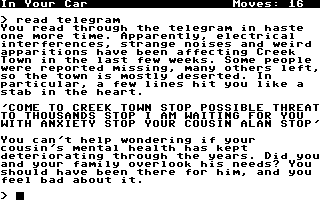
Quite unexpectedly, you received a telegram from your cousin Alan. A few years
had passed since you last talked to him. It turns out that he now lives in
Creek Town, a small settlement in the southern part of Louisiana. In his
telegram, Alan warned about a looming danger so grave that it could affect
thousands of people.

Now Alan was known to have had mental health issues in the past, so you didn't
know what to make of this. Worried about the health of the cousin you hadn't
seen in a while, you decided to pack your bags and pay him a visit.

When you approached the edge of town, your car had electrical problems and you
had to stop at the local service station to get it seen to. You hoped to meet
Alan while it was getting fixed and, in the meanwhile, uncover the truth
about the looming danger that he alluded to.

Genre: Science Fiction

Difficulty level: Medium/Easy

Note: This is the first game in the Murray Shannon series. The games are
self-contained, but it is recommended that you play them in order. The series
consists of:

    Murray Shannon series #1: The Seeds of Evil (this game) Murray Shannon
    series #2: The Horror of Goldmine City (coming soon)

Instructions

This is a traditional text adventure. A text adventure is a form of computer
game that presents you with a story. You take on the role of the main
character in the story and control that character's actions. The story has a
goal and you will need to solve puzzles to achieve that goal. The computer
tells you where you are, what you can see and what's happening around you.
You can then move around, examine the items you find and manipulate those
things by telling the computer what to do using simple English commands.

Commands consist of a verb phrase, optionally followed by a noun phrase. Most
commands can be abbreviated to a verb followed by a noun. For example, OPEN
THE CAR TRUNK can be abbreviated to OPEN TRUNK.

If a preposition follows the verb, this may alter its meaning. For example,
GET HORSE will attempt to pick up the horse, but GET ON HORSE will attempt to
mount it.

In some cases, the verb phrase and first noun phrase may be followed by a
second noun phrase. The two noun phrases are usually separated by a
preposition. For example, HIT MAN will attempt to hit the man with your
hands (as you didn't specify a second noun phrase), but HIT MAN WITH ROCK
will attempt to hit the man with the rock. If you only use a verb and a noun,
the game will generally tell you if it needs an extra phrase or implicitly
try to deduce what is needed for the second phrase.

Don't panic! It's not as complicated as it sounds. Just use simple English
sentences starting with a verb and it will all feel quite natural. Movement

To move around, use commands like GO NORTH and GO SOUTH. You can move in any
of the four cardinal compass directions, as well as UP and DOWN. To save
typing, movement commands can be abbreviated to N, S, E, W, U and D. You can
sometimes use other movement commands such as IN, OUT, ENTER, EXIT, CLIMB,
GET IN or GET OUT. These will be reasonably obvious when the time comes.
Examining things

Make sure you EXAMINE everything you come across, even insignificant things
like scenery and objects mentioned in room descriptions, as subtle hints and
clues are scattered everywhere. To save typing, EXAMINE can be abbreviated to
X. For example, EXAMINE CABINET can be abbreviated to X CABINET.

You can also try your other senses when it seems appropriate, e.g. SMELL,
TOUCH or LISTEN. Unlike EXAMINE, these actions aren't necessary to solve any
puzzles, but may prove useful at some point in the game. Manipulating
objects

Apart from examining things, most of your time will be spent manipulating
objects. Use commands like GET or TAKE to pick up an object, e.g. GET
SHOTGUN. Use commands like DROP or DISCARD to drop an object, e.g. DROP
SHOTGUN. Use WEAR to wear something, e.g. WEAR HAT. Use REMOVE to remove
something that is already worn, e.g. REMOVE HAT.

To see what you're currently carrying and wearing, use INVENTORY (or I). As
you're not a pack horse, you can only carry ten items at a time, plus
whatever you're wearing.

There are many other verbs that can be used to manipulate objects. These will
be fairly obvious when the time comes. Common verbs include OPEN, CLOSE, EAT,
DRINK, READ, SHOOT and so on. Use PUT, PLACE or INSERT to put objects into
containers or on supporters, e.g. PUT BATTERY IN CASSETTE PLAYER. Advanced
features

You can use IT or THEM to refer to the noun used in the previous command, e.g.
EXAMINE BAG, OPEN IT (for a singular object) or TAKE BEANS FROM BAG, DROP
THEM (for plural objects). You can also use HIM and HER to refer to male and
female characters used in the previous command, e.g. TALK TO DOCTOR, ASK HIM
ABOUT MEDICINE.

You can refer to multiple objects by separating the objects with AND, e.g. GET
NEWSPAPER AND KEY. Using IT and THEM in the next command will only refer to
the last of those objects, e.g. EXAMINE IT will refer to the key.

You can use ALL to refer to all the appropriate objects with GET and DROP,
e.g. GET ALL to get everything in the current location, GET ALL FROM TABLE to
get everything on the table, DROP ALL to drop everything you're holding, but
not wearing.

When using ALL, you can use EXCEPT or BUT to exclude some objects, e.g. DROP
ALL EXCEPT REVOLVER.

Finally, you can enter multiple commands on the same line by separating them
with a period, e.g. EXAMINE BOX. OPEN IT. Other commands

Use LOOK (or L) to refresh the display.

Use VERSION to get the game version. Use ABOUT or INFO to get background
information and credits for the game. Use CREDITS to get the credits only.

Use SAVE to save your progress. Use RESTORE to restore a saved game.

Use UNDO to undo the last move. This is handy if you get killed, change your
mind or make a mistake. You can get killed in this game, but you shouldn't be
able to get into an unwinnable situation.

Use AGAIN (or G) to repeat the last command.

Use WAIT (or Z) to do nothing apart from pass the time.

Use HELP to get a brief reminder of how to play the game or HINT to get a
context-sensitive hint related to the current location.

Use RESTART to restart the game from the beginning. Use QUIT (or Q) to quit
without restarting. (Don't use QUIT with the online version of the game, as
the game will appear to be locked up. If this happens, press the Back button
in your browser.)

Most importantly, have fun and enjoy the game. Keyboard shortcuts

Some interpreters have keyboard shortcuts. If you are using an interpreter on
a computer with a conventional keyboard, most will allow you to press the up
and down arrow keys to cycle through your past commands. This is handy if you
want to repeat the previous command or correct a typo.
------------------------------------------------------------------------------
Some useful keyboard shortcuts
------------------------------------------------------------------------------
       [PAUSE] - stop/continue game
          [F9] - quick load game state
         [F12] - quick save game state (still stored after leaving the site)
         [F11] - toggle fullscreen mode
  [ScrollLock] - quick switch control ports
    [PageDown] - make a screenshot (320x200)