ACE 2
combat flight simulator game for Commodore 64, 1987
------------------------------------------------------------------------------
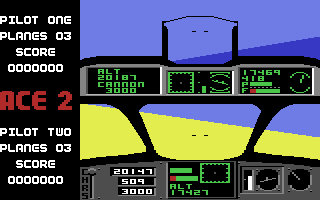
Air Combat Emulator Two (ACE 2) is a head to head flight and combat simulation
for one or two players, each flying a different type of fighter. Plane One is
a carrier based aircraft, whilst Plane Two is stationed at an airbase. In the
single player mode, the human controls Plane One, and the computer flies
Plane Two, using very advanced artificial intelligence to execute both
offensive and defensive manouvres. Plane Two is from a desert country, with a
western coast line. Plane One is based on a foreign aircraft carrier, which
is positioned out of territorial waters.

ACE 2 is really two games:

CLOSE RANGE DOGFIGHT

Both aircraft are armed with aerial cannon, and with close-range
heat-seeking missiles. They are placed at random map positions, but
fairly close to each other. The planes must fight each other using the
available weapons, and if one aircraft is shot down, the game continues,
both pilots receiving a fresh plane. The game ends when one of the pilots
has no more aircraft left.

FULL-SCALE AERIAL AND GROUND ATTACK

The country of Plane One has positioned a Spyship, close to the coast of
its rival, whose mission is to monitor an inshore radar station. Contrary
to all expectations, the inhabitants have reacted aggressively to this
action, and have sent a single plane, from an airbase to the east of the
radar station, to destroy any enemy aircraft, and sink the enemy vessel.
Help is summoned, and a single, carrier based fighter is sent, with
orders to shoot down the attacker, and then to destroy the aforementioned
radar station. Each aircraft has an aerial cannon, and can be further
armed with a variety of short and long range air-air missiles, and an
air-ground missile. The pilots must choose the weapon load; the section
Arming The Aircraft explains this fully.


AIRCRAFT FLIGHT CONTROLS

PLANE ONE

JOYSTICK - Put the joystick into Port 1
F - Increase Engine Power
S - Decrease Engine Power
X - Switch to Map View
E - Select Weapon
Q - If the aircraft is not threatened by an enemy missile, this shows the
number of Flares and Chaff pods available, but if it is being chased by a
missile, it fires a flare to decoy a heat-seeking missile, or some chaff, to
deflect an incoming radar guided missile.

PLANE TWO

JOYSTICK - Put the joystick into Port 2
H - Increase Engine Power
K - Decrease Engine Power
V - Switch to Map View
U - Select Weapon
T - Monitor flare and chaff levels or launch flare/chaff

ADDITIONAL CONTROLS

F3 - Quit game and restart (Hold the key down)
F5 - Turn Music on/off during game (Hold the key down)

QUICK PLAY GUIDE

STALL SPEED             140 Knots.
CEILING                 60000 Feet.

RETURNING TO CARRIER
Plane One fly off the west side of the map, at less than 1000 feet.
Plane Two fly off the east side of the map, at less than 1000 feet.

CANNON (C)
Use against enemy aircraft, at range of less than 1 mile.

HEAT-SEEKING (H)
Fire at aircraft, at range of less than 8 miles.

RADAR-GUIDED (R)
Fire at aircraft, at range of less than 25 miles. This must be guided to the
target.

AIR-GROUND/SHIP (S)
Fire at ground targets, from an altitude of less than 2000 feet, at a speed of
less than 500 knots. Guide it to the target.


FLYING THE AIRCRAFT IN 'ACE 2'

This part of ACE 2 has been designed as a simulation of flying a Mach 2 combat
aircraft, but with many of the complex and difficult aspects of piloting
removed. Here are some of the things about which you don't need to worry: -

    Undercarriage control
    Flaps setting
    Rudder Control
    Engine Temperature
    Decrease in turn rate at very low and very high speed
    Keeping below maximum safe speed
    Avoiding maximum g-forces

The following information applies to flying either aircraft.

ENGINE POWER

Use the two keys specified, to increase the power of your turbofan jet engine.
At more than 75% power (that is, when the thrust bar indicator on your
instrument panel is more than three-quarters full), the afterburners are
engaged. This drastically increases thrust, but at the price of heavy fuel
consumption. Afterburners are needed to fly at speeds above Mach 1.0
(about 760 knots).

USING THE JOYSTICK

Moving the joystick up or down will change the pitch angle of the aircraft. If
the plane is flying upside down, pulling the joystick back will cause the
aircraft to dive; when the plane is not upside diwn, the aircraft will climb.
Observe your pitch indicator. In order to turn the plane, it must be put into
a bank. Moving the joystick left or right will do this. To turn quickly, put
the plane into a steep bank, and pull back on the stick. Note that when the
aircraft is in a steep bank, moving the joystick up or down will have little
or no effect on the pitch of the plane.

STALLING AND CEILING

Stalling occurs when the speed of the aircraft is not sufficient to keep the
aircraft in flight. In a real aircraft, the stall speed varies according to
its situation, but in ACE 2 it has been fixed at 140 knots. The ceiling
(maximum altitude of the aircraft) is 60000 feet.

HANDS ON THROTTLE AND STICK CONCEPT (HOTAS)

Real aircraft, such as the F-18 Hornet, and the F-15 Eagle, use the HOTAS
concept in the design of their flight controls. The most important controls
that are needed by the pilot during aerial combat are placed on either the
throttle (the lever to control the engine's power), or the joystick. The
pilot's left hand is usually on the throttle, his right hand on the stick.
The flight controls to ACE 2 have been designed in a similar way; all the
controls for Plane One are at the left of the keyboard, and those for Plane
Two are at the right. We recommend that each player sits to the appropriate
side of the computer, with his right hand on the stick, and the fingers of
his left hand on, or near the thrust, weapons selection, and defence keys.
You may wish to vary this arrangement to suit your own needs.

SCORING

CANNON HIT ON TARGET AIRCRAFT 	  20 POINTS
MISSILE HIT ON TARGET AIRCRAFT 	  50 POINTS
ENEMY AIRCRAFT DESTROYED 	     200 POINTS
ENEMY GROUND TARGET DESTROYED 	2000 POINTS

DEFENDING YOUR AIRCRAFT

If an enemy missile is fired at you, launch flares or chaff (the game selects
the correct one), to decoy the missile. You have 6 flares, and 6 chaff pods.
Flares and chaff are most effective when the missile is about 1 mile away;
the instrument panel will tell you the range. Either climb or dive to change
your altitude by several thousand feet, to avoid the missile.

If an enemy aircraft is behind you, and quite close, either turn sharply, or
pull up quickly, to move away from it. If the range is less than a mile, and
you cannot get away from it, keep banking, pulling back, then rolling to a
different angle, and pushing forward, to avoid the enemy cannon fire.

When attacking a ground target or ship, watch out for enemy surface to air
missiles, and take the measures described above, to avoid them.

If you are hit, your controls will not respond for a few seconds, during
which, you are very vulnerable to another missile, or cannon fire. So, if you
are being chased by a missile, fly away from the enemy, as you take evasive
action.

RETURNING TO BASE

If your fuel or weapons are low, or your plane has been hit several times,
return to your base, to be repaired, re-armed and re-fueled.

Plane One must fly off the west side of the map, at less than 1000 feet, to
return to the carrier.

Plane Two must fly off the east side of the map, at less than 1000 feet, to
return to its airbase.

FLYING A COMBAT MISSION

New pilots are recommended to fly against the computer, at level one, to gain
combat experience.

Your aircraft is primarily an air superiority fighter, designed to shoot down
the other plane, but also has a secondary air-ground role, employed in the
full-scale conflict game.

When fighting an aircraft, try to gain height, so that your machine will be
faster, and more agile, in the less dense air. Select the weapon that you
wish to use, and close to the correct range. You will find yourself
distracted and momentarily confused if you look at the other player's
instrument panel. Don't do it.

Flares and chaff are only partially effective against incoming missiles, so it
is best to take evasive action as well. Enemy missiles cannot be shot down.

Remember that your plane can fly faster at high altitudes (30000 feet or more
is ideal). High speed will be needed to reach a distant target, or to escape
from conflict zone, and return to base.

If you are trying to flee, and the enemy is constantly close behind you, try
slowing down, then pulling back on your stick until you face him, then firing
a heat-seeking missile (it is best to save one for an escape), which should
cause the enemy to take evasive action, and 'buy' you some distance.

Try to attack the enemy plane from approximately the same altitude (to within
10000 feet).

You can collide with the enemy plane, so take care!
------------------------------------------------------------------------------
Some useful keyboard shortcuts
------------------------------------------------------------------------------
       [PAUSE] - stop/continue game
          [F9] - quick load game state
         [F12] - quick save game state (still stored after leaving the site)
         [F11] - toggle fullscreen mode
  [ScrollLock] - quick switch control ports
    [PageDown] - make a screenshot (320x200)